About Tullow Parish
Tullow Parish is a warm and welcoming Church of Ireland community, rooted in faith and committed to serving the people of Carrickmines and Foxrock in Dublin 18. We are a congregation spanning every generation — united by worship, friendship and a shared desire to make a difference in our community.
Tullow Parish Today
Tullow Parish is situated in the southern suburbs of Dublin, serving the communities of Carrickmines and Foxrock in Dublin 18. We are a warm and active Church of Ireland congregation at the heart of our local community — a place where faith, friendship and service come together across every generation.
Our parish offers regular Sunday worship, a varied programme of activities, and a genuine welcome to all who come through our doors — whether lifelong members or first time visitors.
Tullow Today – A Church at the Heart of the Community
In 2018 an extensive and detailed consultation process took place with parishioners to create a long-term future ‘Vision for Tullow’. A report was subsequently created, adopted by the Select Vestry in January 2019, and presented to the parish at the following Easter General Vestry. A copy of the report was also emailed or posted to every parishioner. Although disrupted by Covid, the majority of recommendations in the report have been actioned and are in place. A review of the report in January 2025 confirmed this.
Among the actions recommended in the report was a leaflet aimed at new residents emphasising that “Our doors are open to all, particularly those new to the area, to join our church and community”.
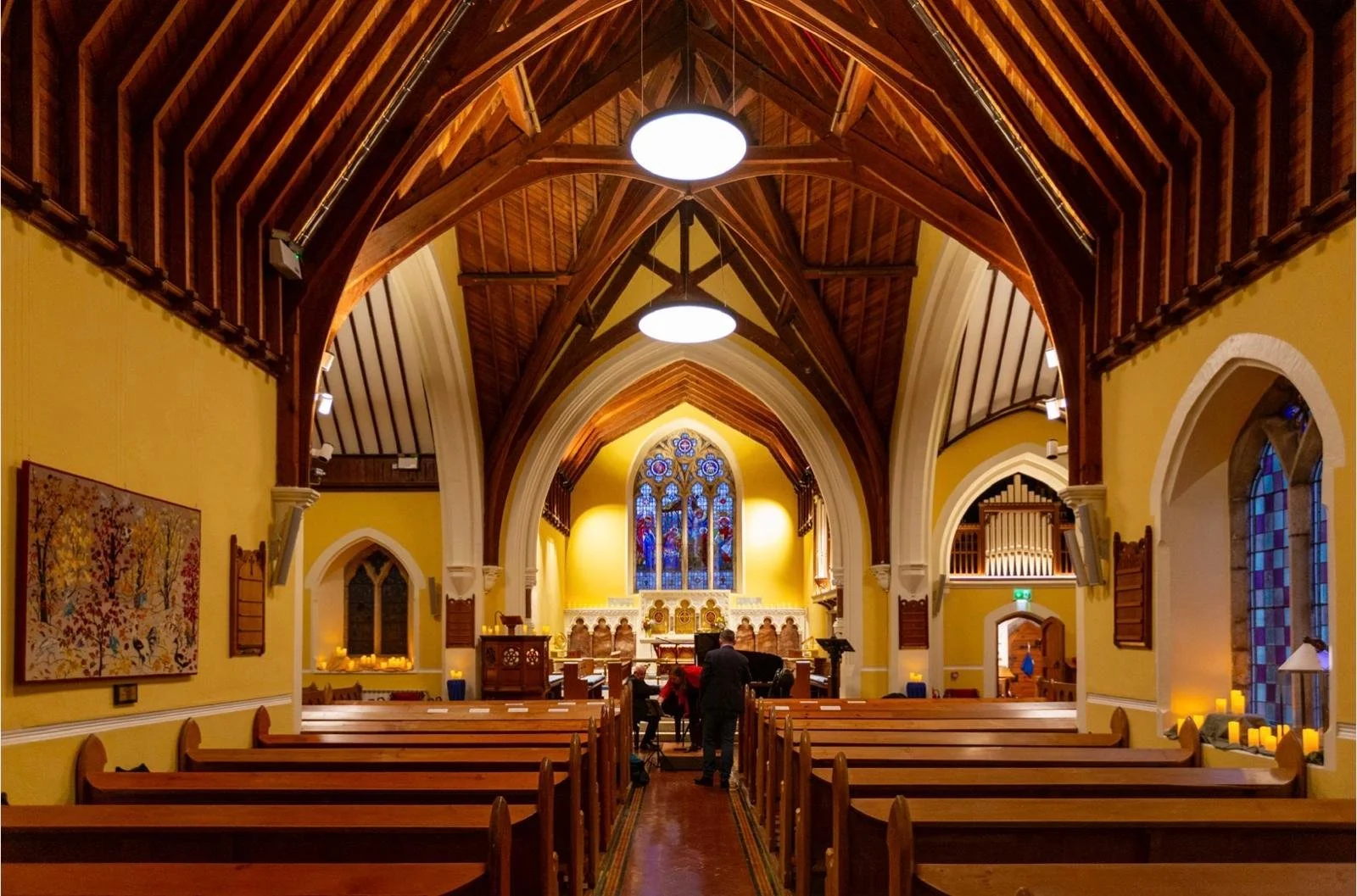
Tullow Parish is deeply rooted in its surrounding community and plays an active role in local life. The parish maintains strong links with community and enterprise initiatives that support civic pride, creativity, and collaboration. The church building itself is a vibrant cultural space, regularly hosting a wide range of artistic and musical events that attract diverse audiences. The parish also celebrates a rich cultural and literary heritage that continues to inspire engagement well beyond the local area. This legacy has fostered long-standing partnerships, recurring festivals, and creative programmes that draw visitors from across Ireland and internationally. Through these connections, the parish continues to be a place of welcome, imagination, and shared experience, contributing to the cultural, spiritual, and social vitality of both the local community and the wider region.
Parish events such as the annual Carols by Candlelight and Carols Around the Crib for little ones attract people from across the religious spectrum, with strong local attendance highlighting the community’s active support and sense of comfort and belonging within the church.
Our Location
Tullow Parish is located in the southern suburbs of Dublin about 13km from the city centre. It is the smallest geographical parish in the Church of Ireland with a boundary covering parts of the M50, N11 to the west/east, R118 and R113 to the south/north, generally comprising Foxrock, Carrickmines, Cornelscourt and Leopardstown. Although the official address is Carrickmines, the parish location is also often referred to as Foxrock, as Carrickmines has become closely associated with the large retail park near the M50 which is at a distance from the church.
Our Worship
Sunday services comprise 8.30am Holy Communion and 10.30am Morning Prayer. Parish Communion is celebrated at 10.30am on the first Sunday of the month and a Family Service with Sunday Club on the second Sunday of the month, also at 10.30am.
Wednesday morning 10.30am services comprise a mix of Holy Communion, a Service of The Word and The Litany.
A very talented young organist is employed who is a huge asset which adds immeasurably to Services.
Coffee is served in the Parish Hall after both the Wednesday and Sunday Morning Services, with some exceptions for summer and other holiday times. This is very popular with attendees and enables new parishioners and visitors to be welcomed.
Children are important members of the parish, participating in both the Family Service and Junior Church Warden roles.
As children in the parish reached confirmation age in previous years, many naturally moved on to other life pursuits, and the economic impact of the financial crash from 2008 onwards led to fewer young families settling in the area for a time. Over the past few years, however, encouraging signs have emerged with younger families returning and attending church regularly. In response, the Select Vestry has proactively arranged Safeguarding Trust training for a number of volunteers, enabling the planned restart of the Sunday Club. This initiative has been warmly welcomed by younger parents, demonstrating the parish’s clear commitment to providing a safe, inclusive, and supportive environment for children and families.
Church services are generally focussed on an all-age basis, with occasional and annual Services such as Easter Day celebrations, the ecumenical Service of Remembrance, Carols Around the Crib on Christmas Eve for little ones, Carols by Candlelight, Christmas Day Family Service and Harvest Thanksgiving service draw cross-community participation.
Our Activities
The range of parish activities includes the Church Choir, Indoor Bowling Club, Badminton Club, Crafts Club, Monthly Book Club, Evergreens Walking Club, and Tullow Friends. Youth activities include Guides.
The parish hall is also leased on a regular basis for non-parish activities such as Speech and Drama, Pilates, Yoga, and a thriving multi-cultural pre-school group.
Our History
The history of Tullow Parish was written by the late Most Reverend George Otto Simms, former Archbishop of Armagh and Primate of All Ireland.
THE 12TH CENTURY ORIGINS
Tullow Church (Church of Ireland) Brighton Road, Carrickmines, Dublin 18 is a vibrant and welcoming church serving about 200 families. It is within walking distance from both Foxrock and Cornelscourt villages.
The original ruined church dating from the late 12th century is said to have been founded by St.Brigid. It is known as Tully church and is to be found at Lehaunstown about a mile up a small road off the Brennanstown Road. It is a rather pleasing stone ruin with a wide Romanesque arch opening into the chancel. The nave has disappeared, the stones probably taken by the local farmers for building over the years. Scholars who have studied the history of Tullow say that the founder was not the famous St.Brigid of Kildare but by another saint of the same name. The church was in use up to about 1615. It came under the authority of Christchurch Cathedral who supplied clergy to keep it going. It was reported to be in good condition when inspected in 1615, but according to a report in 1630 had been badly damaged in recent storms. After that it was abandoned and fell into ruin. The parish was united with Monkstown, together with Kill, Dalkey and Killney. And parishioners of Tully had to go to Monkstown.
Tully means hillock and the church in an elevated position would have been a good centre for the local farming community. Its full name was Telach-na-nun ecspop (Tullow of the bishops) and it must have been an important venue if bishops met there. There is a legend that seven bishops started out from there to visit St Brigid at Kildare. Elsewhere these bishops are mentioned as the "Seven Bishops of Cabinteely" (Alice Curtayne, Saint Brigid of Ireland) This brings us right back to late fifth or early sixth centuries when Brigid was around. Could it possibly be that the scholars were wrong about the founder?
It is probable that there was a wooden or clay and wattle church way back at the time of the Celtic Church. Grave slabs in the ruin predate the stone church, and the two high crosses may also be older. One cross stands on a plinth outside the church and the other is in a field opposite. When the Normans came they brought with them the skills of building in stone.
For anyone interested in archaeology or history there is a sign post near the Cabinteely end of Brennanstown Road pointing to Tully church ruin.
THE PRESENT CHURCH
The story of the present church begins in 1860. The mother church at Monkstown was finding it difficult to conveniently accommodate the growing numbers of those who were attending the Sunday services and the distance from Foxrock was inconvenient for parishioners. There was a growing population in the Foxrock area. The Harcourt Street railway had been running to Bray since 1854 with a stop at Carrickmines In 1861 a new station at Foxrock was added at the request of a developer W.W Bently who was building houses in Foxrock, so the area became a popular place to live.
Rev John Fawcett, a curate of Taney, was nominated to the perpetual curacy of the new district parish of Tullow, with a stipend of £100 payable by the the Ecclesiastical Commissioners. However there was no church building, so at the request of nine Tullow parishioners and the rector and churchwardens of Monkstown, a schoolhouse on the Ballycorus Road was licensed by Archbishop Whately for divine service until a church should be built. This was hardly a very convenient location, but presumably the parishioners had horse transport of some kind.
The site was not purchased until August 1872, but the building must have gone up quickly as the church was consecrated on 14 April 1864! It was a simple rectangular shape, in granite and cost £1600, most of which was paid by the Commissioners. By that time Mr Fawcett had resigned and the Reverend Charles Ormsby Wiley succeeded him. However Mr Wiley was not convinced that Tullow could exist as an independent parish. He felt that many potential parishioners would attend Stillorgan or Kilternan, and a proposal that Tullow would be united with Kill and become a chapel of ease to that of Kill with one service a week to be at Tullow, was accepted.
However the select vestry of Tullow, showing commendable initiative, reversed the decision, and expressed the wish that Tullow remain separate and independent. This was agreed and Mr Wiley continued until 1873 when he was called to the parish of Crossmolina, and the reverend Edmund Robinson was appointed.
THE RECTORY
It was then that an official residence on Torquay Road, was acquired. This house proved unsuitable for Dr Ronald McDonnell who succeeded Mr Robinson and was let and finally sold. Dr McDonnell must have lived elsewhere because the new rectory on the site of the church was not yet built. The building of the rectory was completed in 1890. A coach house and stables were later added for the use of the incumbent and to accommodate the carriages for those who drove to church.
INCUMBENTS
Successive rectors were John Pirn, (1885-1888) George Wallis Newport Clark (1888-1928), William Baillie (1928-1934), Alexander Duff Moore (1934-1937), Edward John Young (1937-1945), William Cecil Pauley (1945-1950), Thomas Noel Desmond Salmon (1950-1962), John Bourke Neligan (1962-1971) William Warburton Rooke (1971-1978), Cecil Hyland (1979-1990), Kenneth Kearon (1990-1999), Cecil Bryan (1999-2007), (Leonard) John Tanner (2007-2026).
CHURCH EXTENSION
After the rectory was built and the congregation was increasing, thoughts were turned to the possibility of extending the church. This was eventually done and completed by 1904. The original building became the transepts and the nave and chancel were added at right angles. This must have been a major upheaval, and services during construction were held in a large room in Craigholm at the corner of Kerrymount Avenue, generously lent by the Read family.
PARISH HALL
A modern church hall was built during the incumbency of Mr Hyland, replacing a previous hall dating from 1910, and later an attractive memorial garden was laid out on part of the garden at the rear of the rectory.
ORGAN
The present organ was installed and dedicated by Archbishop Gregg on 5th April 1929 It was overhauled in 1963. Since then it has been serviced and kept in good order. This instrument replaced a previous organ dating from 1894, which in turn replaced the harmonium which had served since 1864. There is an amusing mention in the records of an "organ blower" being employed in 1867 at the lordly sum of £2.14.0 per annum! Electricity came to Foxrock in 1930 and an electric blower was then installed.
The information above has been taken from "TULLOW’S STORY" By Dr. G.O.Simms